
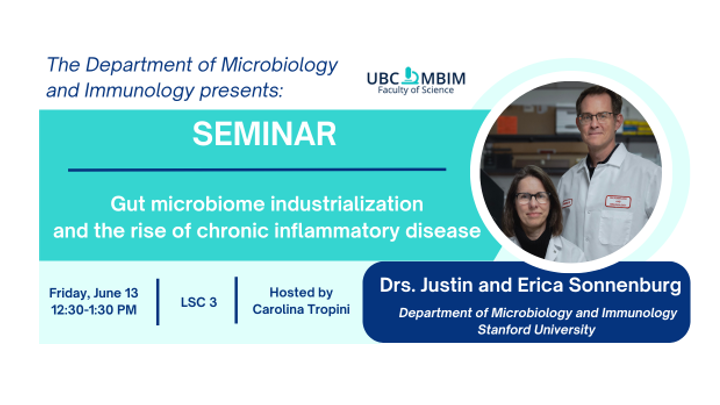
Seminar: Gut Microbiome Industrialization and the Rise of Chronic Inflammatory Disease
Abstract: The human gut microbiome is tightly linked our health. Our analyses of diverse human populations from around the globe, ranging from hunter-gatherer to industrialized, show that the gut microbiome is profoundly influenced by lifestyle. With a large collaborative team, we conducted deep metagenomic sequencing of the gut microbiomes of Tsimane horticulturalists from Bolivia and compared them to those of Hadza hunter-gatherers from Tanzania. Despite their ancestors diverging tens of thousands of years ago, these two Indigenous, non-industrialized populations share >1200 microbial species—most of which are absent in industrialized populations. Population genetic analyses of shared bacterial species revealed signatures of microbial divergence and gene flow consistent with prehistoric human-microbiome co-migration. Estimated split times broadly align with major events in human migration, including the out-of-Africa dispersal and the peopling of the Americas. These findings support the hypothesis that a diverse gut microbiome co-migrated with humans during our global dispersal and has persisted over millennia. However, many of these microbial species are now disappearing from industrialized microbiome, with unclear implications for human health. We are also investigating whether diet and microbial therapies can address deficiencies in the industrialized gut community. Molecular mechanisms of host-microbial interaction are pursued using an array of technologies and experimental approaches including gnotobiotic and conventional mouse models, quantitative imaging, and a metabolomics pipeline focused on investigating microbiota-dependent metabolites.
Zoom information:
Meeting ID: 98814 231272
Password: 231272
LSC 3 (Life Sciences Institute - 2350 Health Sciences Mall) & Zoom MBIM itsupport@microbiology.ubc.ca America/Vancouver publicSeminar: Gut Microbiome Industrialization and the Rise of Chronic Inflammatory Disease
Abstract: The human gut microbiome is tightly linked our health. Our analyses of diverse human populations from around the globe, ranging from hunter-gatherer to industrialized, show that the gut microbiome is profoundly influenced by lifestyle. With a large collaborative team, we conducted deep metagenomic sequencing of the gut microbiomes of Tsimane horticulturalists from Bolivia and compared them to those of Hadza hunter-gatherers from Tanzania. Despite their ancestors diverging tens of thousands of years ago, these two Indigenous, non-industrialized populations share >1200 microbial species—most of which are absent in industrialized populations. Population genetic analyses of shared bacterial species revealed signatures of microbial divergence and gene flow consistent with prehistoric human-microbiome co-migration. Estimated split times broadly align with major events in human migration, including the out-of-Africa dispersal and the peopling of the Americas. These findings support the hypothesis that a diverse gut microbiome co-migrated with humans during our global dispersal and has persisted over millennia. However, many of these microbial species are now disappearing from industrialized microbiome, with unclear implications for human health. We are also investigating whether diet and microbial therapies can address deficiencies in the industrialized gut community. Molecular mechanisms of host-microbial interaction are pursued using an array of technologies and experimental approaches including gnotobiotic and conventional mouse models, quantitative imaging, and a metabolomics pipeline focused on investigating microbiota-dependent metabolites.
Zoom information:
Meeting ID: 98814 231272
Password: 231272